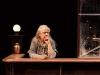
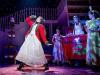
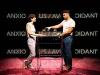
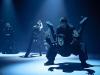
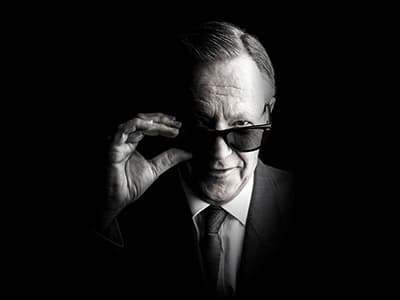
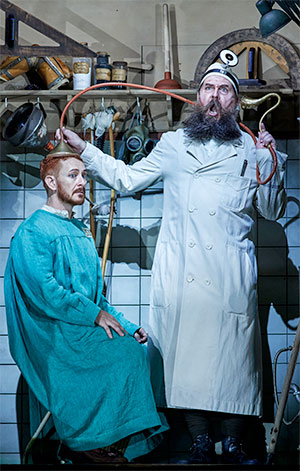
 Left – Michael Honeyman and Richard Anderson. Cover – Michael Honeyman. Photos – Keith Saunders
To those of us who received their musical education in the third quarter of last century, the music of Berg, especially the Violin Concerto and his two operas Wozzeck and Lulu, were like a beacon of light in a maelstrom of ever-increasing dissonance that led to the nadir of Modernism that was Darmstadt. Yet this music, with its radical expansion of dissonance typical of the Second Viennese School, is still not for the faint-hearted, and so it is greatly to the credit of Opera Australia, and its artistic director Lyndon Terracini, that they have mounted this production. It is their first production in an exciting new season which shows signs that the company is finally emerging from the doldrums of Puccini and Rogers and Hammerstein, a season which also includes an opera by Australia’s leading woman composer, and aims to address a different section of the opera-loving public.
For Wozzeck, Berg took 15 of the 27 scenes from Georg Büchner’s play Woyzeck, left incomplete at his death in 1837, and rearranged them into three acts of five scenes each. Its eponymous character is an army private, terribly poor, and at the mercy of the cruelty of his superiors. It is the type of cruelty that will be familiar to those who have suffered the humiliations meted out to freshmen at certain colleges, deriving as this does directly from the behaviour of the army. It is a trivial, gratuitous exercise of (male) power which nonetheless has far-reaching consequences for the destruction of civilised values. When the Captain tells Wozzeck that ‘Er hat kein Moral’ (you have no morals) he makes the audience aware that in fact Wozzeck is the only character in the play to have any morals at all, and that his increasing discomfiture and growing madness is a result of not seeing these morals reflected in the behaviour of any of his acquaintances.
This production is an overwhelming triumph. The conductor, Andrea Molino, understands the score so deeply that by the third scene the musical language seemed completely natural, embracing both lyricism and disjunction comfortably. From the opening viola solo, compellingly played by Virginia Comerford, to the sheer power of the funeral march at the end, the orchestra negotiated the remarkable demands Berg places on them seemingly without effort.
Berg makes similarly unusual demands on the singers, asking for various shades of delivery between speaking and singing, and routinely using the extremes of vocal register, including falsetto. The entire cast negotiated these with great skill, but I must single out the spectacular virtuosity of John Longmuir as the Captain, the trumpet-like assurance of John Daszak as the Drum-major, and the gorgeous lyriscism of Lorina Gore as Marie, who abandoned herself to the music just as her character abandons itself to the Drum-major. Michael Honeyman’s rendering of the central character, Wozzeck, grew in stature from the downtrodden army private of the opening into the representative of ‘Wir arme Leut’ (us poor people) who are the true subject of the opera, his beautiful baritone flowering as it did so. The chorus sang what must be the most dissonant hunting song ever, and the remarkable snoring chorus, with absolute conviction.
Holding all this together was the production by that towering figure, William Kentridge. First staged at Salzburg last year, this was the first production of this opera I have seen to approach it fearlessly, penetrate its depths, and come up with something utterly of a piece with it. He did not start, as the directors of both the other productions I have seen did, with the idea that since the score is so complex and so dense with meaning, the set should be simple. For the set, he chose an Escher-like chaos of wooden staircases and gangways with no right-angles, which was very consonant with the early 19th century world of Georg Büchner, the author of the play on which Berg based Wozzeck. Then, taking his cue from the fact that Berg wrote the opera during and just after the First World War, and that the opera’s locus is an army barracks, Kentridge superimposed on the set images derived from photos of that war: ruined fields, severed heads, crashed German planes, maps of the battlefield of Ypres. The result was a visual landscape as complex as the music; furthermore, one that pointed up the large-scale consequences of the mundane vileness of most of the characters, encapsulated by the gratuitous mocking of Wozzeck by the Captain and the Doctor on account of Marie’s affair with the Drum-major.
In presenting this wonderful production of this extraordinary opera, Opera Australia have shown that they intend to move away from the pure entertainment side of art, delightful as that may be, and engage with the deeper purpose art has for us all – to challenge assumptions and reveal the consequences of actions by articulating them in a way that goes directly to the heart.
Opera Australia presents
Woyzeck
Alban Berg
Director William Kentridge
Venue: Joan Sutherland Theatre | Sydney Opera House NSW
Dates: 30 January – 15 February 2019
Bookings: opera.org.au